Tuesday, June 6, 2017

Star Sirius Inspired Naming Dog Days of Summer


A spring holiday that nudges the start of summer, the recent Memorial Day celebration reminds people that the hottest part of the year is coming soon. The months of July and August bring the uncomfortable, humid weather that many people call the “dog days of summer.”

The phrase “dog days” conjures images of yard mongrels seeking relief in shade and water from summer’s steamy heat. However, it’s the star constellation Canis Major that inspired the name.

Canis Major is a group of stars Greek astronomers named in 700 BC. The constellation represents the dog owned by Orion who appears in the nighttime sky in his own group of stars. Orion is the mighty hunter of Greek and Roman mythology.

The bright star Sirius, the nose of the dog constellation, rises and falls with the sun during July and August in the Western Hemisphere. During summer, Sirius is the brightest object in the sky next to the sun. Ancients believed Sirius, called the Dog Star, added to the summertime heat. That’s how the dog days description began.

A third constellation called Lepus, the rabbit, shares the nighttime sky with Orion and Canis Major. The Dog Star chases Lepus, according to Greek and Roman mythologies. Orion is in the sky with his dog that’s chasing a rabbit, composing a nighttime story in the stars.

Recognizing star constellations requires a stretch in our imaginations. Typically, one major part of a star cluster inspires an imaginary figure. Orion, for example, is recognized by three stars that make up the figure’s belt. The rest of the image of Orion can be described as vague at best. The same is true of Canis Major that has Sirius at the tip of the dog’s nose. The rest of the dog’s figure is difficult to accept.

Image result for sirius radio
Sirius Satellite Radio company hosts a play on words for this constellation using a dog as part of their logo! 

Astrology is an old belief that our futures’ can be predicted from star formations. Recognizing the figures in constellations can be interesting and fun. Entertainment is the best reason to view the nighttime skies.

Sunday, May 21, 2017

Flowers in Bloom Influenced Date for Memorial Day

It’s a federal holiday that honors U.S. military personnel who have died while serving in the country’s armed forces. Memorial Day is designated by law to fall late in May on the last Monday of the month. This year that is May 29, 2017.  

May 30th was the original date for the holiday when it began 149 years ago. Decorating veterans’ graves with flowers became an important part of the holiday, and founders of the tradition decided that flowers would be in bloom by that time of the year. Later, Memorial Day became one of the Monday, three-day weekend holidays when the Uniform Monday Holiday Act went into law on the first day of 1971.

Memorial Day originally was named Decoration Day by members of The General Army of the Republic. Members of that group were mostly widows and families of military members who fought on the Northern side of the American Civil War. They encouraged citizens to decorate the graves of Union war dead with flowers and American flags. Members of the organization started the decorating practice on May 30, 1868, in Decatur, IL, shortly after the end of the Civil War.

Confederate States started their own tradition of placing flowers on the graves of fallen soldiers also in May. The custom of using flowers as decoration was important in both the northern and southern states. In the early 1900s, both northern and southern states used May 30th as the official day.

Military units suffered more than 600,000 casualties during the Civil War. That staggering number of military dead required states on both sides of the war to build many additional cemeteries. New graveyards provided the needed space to bury war causalities, and grieving families used flowers to honor the military.

After World War II most state governments began calling the holiday Memorial Day because that name emphasized honoring the memory of fallen soldiers. The U.S. Congress officially changed the name in 1967.

Because its’s held during warm, spring weather, Memorial Day marks the unofficial start of the vacation season. Labor Day marks the unofficial end of summer.

Formal flag ceremonies honor the more than one million men and women who gave their lives in service to the United States during all American war conflicts. One formal ceremony includes the flagpole in front of the U.S. Capitol Building. The flag that flies above the Capitol is raised to full staff Memorial Day morning and immediately lowered slowly to half-staff.  At noon the flag is raised again to full staff and remains there all day.


Thursday, May 11, 2017

Hyperloop Project Can Move People and Goods Near Speed of Sound

Image result for Hyperloop TrainHyperloop is an experimental, ground transportation system that’s designed to reach speeds faster than 700 mph. Experimental prototypes would hold passengers and freight in a twenty foot capsule that floats inside a partially vacuumed tube. Passengers and freight will travel both above ground and underground.

Magnets work to levitate capsules that get pushed through the tube by high-pressured air. The capsules have accelerated to several hundred miles per hour within seconds during experiments conducted over short distances.

Two major corporations, both located in California, are working to get a functioning Hyperloop system working sometime by 2021. Hyperloop One is a Los Angeles, CA, company that sprung from an idea publicized by Elon Musk, a top official for Spacex, Tesla Inc. and Paypal.  Musk was a concept coordinator for the Hyperloop project when he presented the idea to a national conference in August 2013. He decided not to participate personally in the project.

Hyperloop Transportation Technologies (HTT) is a second company that’s developing the transportation system designed to approach the speed of sound. HTT started in November 2013 and runs its operation in Culver City, CA.

The idea of using air pressure to move objects through a tube is nothing new. Major department stores used a similar method of sending paperwork through elaborate vacuum tubes connected to all floors of the buildings.

Drive-in windows at banks show the concept of Hyperloop transportation. Customers put their bank requests into a capsule that travels through a vacuum tube to an employee several feet away. A vacuum system sends the completed bank transaction inside the capsule back to the bank customer who doesn’t have to leave the car.

Building a Hyperloop system involves putting thousands of miles of tubes above and below ground. These tubes would be approximately nine feet in diameter and would house capsules that would hold about 12 people or a few tons of freight. Both HTT and Hyperloop One plan to build inner-city and suburban systems.

India’s government has an agreement with HTT to build one of the super speed systems between New Delhi and Mumbai. The Hyperloop engineers claim the travel time between the two major cities in India would be reduced to 70 minutes instead of the current train trip of 18 hours.

Image result for Hyperloop TrainOther countries have expressed interest in getting Hyperloop systems inside their borders. The Czech Republic, and the United Arab Emerits invited HTT to build prototype systems for them. Speed estimates include cruising speeds of 650 mph to top speeds faster than the speed of sound at an incredible 800 mph.

Hyperloop engineers claim that the capsules would run completely silent inside the outer tubes. An electrical motor would provide the acceleration and stopping methods of the pods that are designed to float inside the outer shells.

Beach Pneumatic Transit 01.jpg
Beach Pneumatic Transit
A prototype for an underground transit system ran underneath New York City from 1870 to 1873. The Beach Pneumatic Transit carrier put passengers into a railroad-type vehicle that moved by an air propulsion method similar to the Hyperloop. Up to 22 people were moved underneath Broadway for about one city block when the vehicle stopped and reversed direction to carry passengers back to the start of the tunnel. 

Passengers paid 25 cents to ride the transit car one city block and back. More than $7,000 was collected annually during the first two years of the prototype’s operation. It was more a curiosity than a practical way of transporting passengers, but the experiment proved the validity of using air pressure to move people from one spot to another worked.

Alfred Ely Beach was the developer and chief inventor of the transit system. He spent $350,000 of his own money to finance the experiment. That equals $8.75 million in today’s dollars. Beach wanted to increase the tunnel distance to five miles in the second phase of the transit operation. However, public interest in the tunnel diminished during the third year, and city government officials refused to raise tax money to fund the project.

Developers of Hyperloop One and HTT keep speculating that they will get a working system operational sometime before 2021. Their optimism is farfetched since the basic ground work is in the infancy stage.

Officials have estimated costs would be somewhere from 200 million to 400 million per mile to construct the first Hyperloop. That’s not more than a wild guess. The backers for Hyperloop One and HTT will have to be wealthy nations to make the superfast transportation systems a reality. 

Transportation of freight, goods and products is the future of the Hyperloop. Passenger costs will be so expensive that only wealthy citizens will travel at the supersonic speeds. That was found to be true during the short-lived SST super airplanes that traveled at the speed of sound decades ago.

Wednesday, March 29, 2017

Taco Bell Bought the Liberty Bell—April Fool

The Liberty Bell was part of an elaborate April Fool’s Day hoax 21 years ago when Taco Bell officials said they bought the symbol of America’s freedom. The fast food chain claimed that the company’s name was changed to Taco Liberty Bell.   

The company placed full-page advertisements in seven leading U.S. newspapers on April 1, 1996, announcing the purchase. The newspaper story claimed that the company purchased the national icon to help reduce the country’s national debt.

Thousands of people overloaded national telephone lines when they called Taco Bell headquarters and the National Park Service to find out if the story was true. The curious callers realized they fell for an April Fool’s Day prank when recorded radio spots placed in major markets repeatedly disclosed the joke after 1p.m.

The Liberty Bell was commissioned in 1752 by the Pennsylvania Provincial Assembly. Pennsylvania owns the bell and the park service acts as a custodian and protector of the bell. It’s housed in the city’s Liberty Bell Center inside Independence National Historical Park. To learn more about the Liberty Bell, you can visit my previous blog post, Liberty Bell: Once Sold for Scrap Metal.

The April Fool’s hoax was a financial success for the fast food corporation. The campaign cost about $300,000.00 and generated an estimated $25 million worth of publicity, according to the David Paine Co. Now called Citizens Relations, the large advertising firm was hired to spearhead the hoax. Taco Bell claimed a $1 million jump in business during the first two days of the April joke.

“Entrepreneur Magazine” lists the hoax among the top 100 April Fool’s Day tricks of all time. And The Museum of Hoaxes, the source of a popular website since 1997, ranks it number four on its list of top April 1st gags. The museum has its headquarters in San Diego, CA. Historical deceptions dating from the Middle Ages up to the present are illustrated inside the museum.

Timing of the Taco Liberty Bell stunt helped make it successful. It was a time before false and deceptive information became a daily part of the internet. David Paine, founder and owner of the advertising company, often spoke about the success of the Taco Bell campaign. According to Paine, people trusted news that came from well-known, national advertisers such as the Taco Bell Co. during the time of the hoax.  Since then the internet has become a source of scams and false information. According to Paine, the influences and easy access to the internet make the public much more cynical. The number of people believing such a gag would be much smaller today.  

Interested in learning more about April Fool's Day? Check out my blog post: The Beginning of April Fool's Day.

Enjoy your April Fool's Day this weekend, and watch out for hoaxes!

Friday, March 24, 2017

Life on Earth Died Long Before Dinosaurs Dominated the Planet

They were the largest land animals that ever roamed the Earth. Dinosaurs inhabited most of Earth’s landmass before going extinct about 65 million years ago.   

Dinosaurs had an extraordinary history. They lived about 160 million years as the dominate life forms on the planet. They became extinct after a major climate change affected Earth. But an even larger earth-wide extinction wiped out most life forms about 90 million years before dinosaurs walked the planet. Nearly all life on Earth disappeared during a period called The Great Dying.

About 252 million years ago, give or take a million years, most terrestrial vertebrates (air breathing animals with spines) disappeared from Earth. It’s dubbed The Great Dying because at least 70 percent of land animals and 96 percent of all marine species died.  

Officially known as the Permian-Triassic (PT) Extinction event, it predated the existence of dinosaurs by millions of years. The PT theory was often ridiculed by the scientific community when it was first discussed by paleontologists in the 1950s. However, evidence supporting the PT explanation was found starting in the year 2000 when geologists began digging through five volcanic ash beds discovered in Meishan, China.

The ash beds continue to provide scientists with evidence to explore the carbon cycles captured in ancient rock formations and lava flows buried deep inside the earth’s crust. Archeologists find concentrations of iridium inside the ancient layers of ash during digs that are relatively new at the China location. Iridium is an element rare to the Earth’s surface but contained in high amounts in comets, meteors, and old volcano eruptions.

Pangaea: Gigantic land mass
before the continents separated
The rare element’s concentration inside the newly found excavated sites dates to the PT period, giving credibility to the often disputed theory that the large extinction did happen.

Evidence from lifeforms that existed at the time of the PT disappeared long ago. Scientists think small animal life forms, even some mammals, existed. But that’s speculation and is nothing more than guessing.   

In theory, the PT event resulted from severe damages to the Earth’s atmosphere from the eruption of hundreds of volcanoes as well as numerous comet and meteor impacts on the Earth. The atmosphere became so polluted that sunshine was blocked from hitting the earth, causing continuous darkness for hundreds of thousands of years.

Oxygen levels in the air slowly depleted, stopping the biological life cycle of plants; the food chain stopped, and animals died off.      

Scientists describe the PT as an event. In scientific terms, the time required for the climate changes to cause The Great Dying could cover a million years or more. Most people can’t relate to the meaning of such a long time as it’s described by experts of geology. An event for most people is a relatively short period of time for a particular occurrence, not a time period that could be more than one million years.     

The ravages to the air and environment increased because Earth’s land mass consisted of a single supercontinent during the Permian era. Called Pangaea, that huge land mass included all the ground areas we identify today as Earth’s seven continents. Pangaea didn’t start to break up until half way into the Triassic period (when dinosaurs flourished) about 175 million years ago.

The size of the single continent contributed to the massive extinction by disrupting the circulation of seawater, making oceans stagnant. This caused a depletion of oxygen in seawater. Sea creatures died, eliminating about 96% of the ocean life.    

Digging in volcano layers
in Meishan, China
Peter Ward, a geologist respected for his work in studying fossils, has studied rock layers from the Permian and Triassic periods. His findings show an abundance of animal fossils in the time up to the end of the Permian period. But throughout the first half of the Triassic period, Ward found very few fossils. He concludes that the lack of recorded life between the two periods proves that The Great Dying occurred about that time 252 million years ago. It was the most catastrophic extinction that killed off Earth’s reptiles, amphibians, insects and plants, according to Ward.

Evidence about The Great Dying remains meager and makes most of the reports about that period strictly speculation. Before the geological findings in China, the idea of the world’s biggest extinction was not accepted as a scientific fact. More discoveries will undoubtedly surface from the China digs and from the hands-on research from determined geologists such as Ward. 

Physical discoveries as basic as skeletons and thousands of fossils have given geologists accurate evidence about the years dinosaurs dominated the earth. Studying chemical residue among Earth’s layers is the only way scientists can find evidence about The Great Dying. The physical evidence disappeared during the more than 200 million years since that cataclysmic event of Earth’s history happened.


Friday, March 10, 2017

Clocks Set to Noon When Time Zones Began

It’s called “The Day of Two Noons.” On November 18, 1883, the four time zones across the United States officially began when clocks were reset to precisely 12:00 noon.

Time zones and Standard Time came out of the necessity of railroads to stay on schedule. Train travel kept improving, shrinking the time between cities, and requiring precise arrival and departure times.

Several competing railroad lines crisscrossed the United States. It was a fast-growing industry that moved people and freight each day over thousands of miles of rail lines that covered North America by the 1880s.

Each community the railroads serviced used their own local times within the same state and often between towns that were only a few miles of each other. The complicated time schedules of each railroad line confused travelers. The different railroad companies worked together to end the confusion of dealing with thousands of different times. The competing railroads collaborated to create what became known as Standard Time across the nation.

The railroads looked to the British Empire’s use of Standard Time as an example of how to make the time zone system work. Great Britain was years ahead of America in making time schedules uniform. British railroads were using a standard time system 36 years before American railroads took the lead in 1883.

American railroads established four time zones that crossed the United States one hour apart from each other with the eastern states beginning each day four hours earlier than the western states. Following the movement of the sun, the four zones each covered approximately 25 percent of the country. The railroads named them the Eastern, Central, Mountain, and Pacific time zones.

American railroads coordinated the extremely complicated time changes on that November day in 1883 when all railroad clocks and many thousand city clocks began Standard Time for their particular zones. 

On November 18th, each clock in the Eastern Time Zone was reset to 12:00 noon when the sun was at its highest position in the sky, making that the second time the clock showed noon. Precisely 60 minutes later, clocks in the Central Time Zone were reset at noon. Clocks in the Mountain Time Zone were next, and “The Day of Two Noons” completed its four-hour trek across the continental U.S. in the Pacific Time Zone when clocks there moved to noon.

Within a year, 85% of all U.S. cities with populations of more than 10,000 (approximately 200 cities) used what became known as Standard Time. But paving the way and shouldering the expenses of starting four time zones remained with the commercial railroads for more than 34 and a half years.

Image result for Interstate Commerce CommissionThe U.S. government finally took over the responsibility of administrating the time zones with the Interstate Commerce Commission when the U.S. Congress made the Standard Time Act a law on March 19, 1918. 

The country’s railroads regulated themselves for more than 34 years concerning the use and revenue requirements of the continental time zones. That would be unheard of in today’s society. The necessity of time zones keeping an accurate measurement of time as the sun passes across our continent extends to all activities in our society. 

Monday, February 27, 2017

Next U.S. State Will be an Archipelago

Alaska became the 49th American state on January 3, 1959. On August 21st that same year, Hawaii joined the United States as state number 50. Both of the last two states are geography unique in that they are located outside the contiguous union of 48 states whose borders touch each other. 

The 50th state has the distinction of being the first “archipelago” which is a nation made up of a group of islands or an island chain. Many of the U.S. territories that are properties of the U.S. are archipelagos. These 16 areas are properties of the United States and are spread across the Caribbean and Pacific oceans.

Assimilating territories into the United States started immediately after the 13 original colonies became independent from England. Pioneers moved westward and slowly settled the land mass that stretched from the East Coast to the Pacific Ocean border.

The United States claimed areas through negotiations and military victories with foreign countries. These areas were first identified as territories and were slowly accepted into the U.S. as states. Arizona, once a territory, came into the union as the 48th state in 1912.

Five of the current U.S. territories are populated and are self-governing. Residents of the territories pay no income taxes. They can’t vote in U.S. presidential elections but they each have one nonvoting member of the House of Representatives.


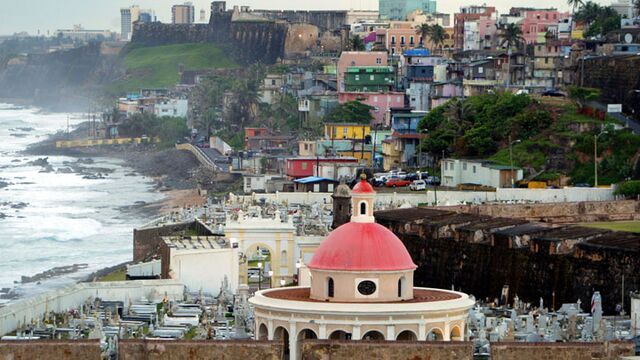
Puerto Rico, the largest territory in area as well as in population, has been considered to be the next territory for statehood. Guam is a distant second place contender to join the union only because 29 percent of that island is covered with American military who manage hundreds of aircraft stationed there for American defense.

Puerto Rico’s 143 islands are located in the northeastern part of the Caribbean Sea. Except for the main two islands, most of Puerto Rico consists of tiny islands, cays and islets. The population of approximately 3.474 million people is much higher than all the other territories combined. Total population for all the 16 territories totals slightly more than 4 million people.


With an area of 3,515 miles, Puerto Rico’s economy is poorer than any U.S. state, and that inhibits the U.S. Congress from extending an invitation to Puerto Rico to seek the 51st state position. The federal income tax that would be generated by Puerto Rico would not come near the expenses the U.S. would spend to provide the social, military and economic benefits all states get from the central government.

Related imagePuerto Rico’s per capita income in 2016 was $27,340.00. That’s well below Mississippi that had the poorest economy of any state last year with a per capita of $32,967.00. A poor economy and a population that speaks primarily Spanish prevent any serious attempts to get Puerto Rico to join the U.S. union. Becoming the 51st state would include the political power of two U.S. Senators and one U.S. Representative as well as full voting rights.

Opinion polls during the last half dozen years show a strong movement among Puerto Rican residents who want to become U.S. citizens. The popularity of speaking English has made it an unofficial second language. Improvements in Puerto Rico’s economy during the next decade will keep politicians looking to that archipelago for possible statehood.

The other three territories that have permanent populations are the U.S. Virgin Islands, the Northern Marianas Islands, and American Samoa.

Eleven territories have no populations and are small islands, atolls and reefs spread across the Pacific Ocean and the Caribbean Sea. They offer no economic advantage to the federal government. For all purposes, they will never be developed into any useful land masses. Those tiny territories are Palmyra Atoll, Baker Island, Howard Island, Jarvis Island, Johnston Atoll, Kingman Reef, Midway Island, Bajo Nuevo Bank, Navassa Island, Serranilla Bank and Wake Island.