Tuesday, October 24, 2017

Unfinished Faces on Mt. Rushmore Will Last Many Millennia

Carving the likenesses of four U.S. presidents into the granite mountain of Mt. Rushmore began in 1927. The 60-foot faces of George Washington, Thomas Jefferson, Theodore Roosevelt and Abraham Lincoln were carved into the granite mountain to attract tourists to the scenic Black Hills of South Dakota.

After 14 years of delays and restarts on the massive project, the Mt. Rushmore carving was dedicated in its uncompleted condition on October 31, 1941. Interest in raising money to finish the massive carving stopped when the United States joined World War II five weeks later.  

Original plans showed that each president’s image would be carved from head to waist. The stone carvers stopped working after completing most details of the faces of the four presidents.  A carved outline of the shoulders and chest for the Washington figure is visible on the mountain. The faces of the four presidents are remarkably accurate in their details, but Lincoln’s likeness has extra stone above his head, looking somewhat like a helmet. And Lincoln’s head has no left ear.

The actual productive work time was about eight years. Delays came repeatedly, and work stopped and later restarted when money to pay the hundreds of workers kept running out. Project officials traveled outside South Dakota to raise money to keep the work going. The delays extended the project by approximately six years.

One major setback occurred during the first part of construction. The head of Jefferson was originally set to be on the left side of Washington. After 18 months of work, the architects decided that the granite on that part of the mountain was poor quality and would not support Jefferson’s figure. The work of a year and a half was blasted away, and Jefferson’s likeness was moved to the right of Washington.

Doane Robinson was the brainchild of the project. He was South Dakota’s official historian. Robinson worked to promote tourism for the state, and he wanted to develop South Dakota’s Black Hills mountain range into a vacation spot. He thought that the Black Hills would draw visitors from all over the world to experience camping and hiking in the dense pine forests. He believed that a spectacular, one-of-a-kind attraction was needed to bring visitors to his state.

Robinson visited a Civil War memorial that was being carved into a cliff face on a huge piece of granite in Georgia during the early 1920s. He was inspired by the project in Stone Mountain, GA, and thought carvings of numerous American heroes could be cut into granite spires that appeared throughout forests of the Black Hills.

Robinson contacted Gutzon Borgham, the sculptor in charge of carving the Civil War memorial. The two men met in 1924, and Borgham immediately agreed to create a sculpture on the scale of the Georgia monument. Borgham had serious disagreements with members of the Georgia commission in charge of that state’s Civil War memorial. And he welcomed the opportunity to leave the Georgia project.

Borgham had already carved the outlines of the Confederate Army figures into the Georgia Mountain. But state officials didn’t like the looks or the positioning of the southern military figures. Two years later, Borgham resigned from the Georgia project and started working on Mt. Rushmore. His initial Civil War design was drilled off Stone Mountain, and a new rendering was carved several feet higher on Georgia’s granite mountain.

The South Dakota delays and disagreements began immediately as Robinson and Borgham argued about which heroes they wanted to depict and the location in the Black Hills. Robinson originally planned to place the carved faces of many American heroes and pioneers onto several granite towers located miles away from Mt. Rushmore.

Borgham insisted on limiting the subjects to four U.S. presidents. In 1927, the chief architect/sculptor began carving on the southeastern, flat face of the mountain called Rushmore. Borgham said the location allowed the rising sun to illuminate the carvings.

Visitors during the first years of the massive Mr. Rushmore project heard explosions and no drilling or carving noises from the granite surface. The workforce used dynamite to clear 90% of the rock before detailed carving of the faces began. After blasting away tons of rock, work crews used pneumatic tools to drill close rows of holes into the granite. Called honeycombing, the holes let the skilled carvers chip away the granite with hand tools.

More than 400 people worked in specialized teams. One group of men on the top of the mountain hand cranked individuals up and down the 500 foot cliff in bosun chairs. The chairs weren’t more than small boards that were suspended by 3/8th inch steel cables, allowing the workers freedom of movement. Men were lowered and raised hundreds of times throughout the work days, depending on weather conditions. Working several hundred feet off the ground with dynamite and precarious equipment could have resulted in several fatal accidents. Surprising, no one died while working on the monument.

Explosive experts were the first laborers to dominate the cliff face. A basic outline of each head was revealed during the first years of blasting tons of rock off the mountain. Men carrying drills created the honeycomb features of the faces. Skilled rock carvers came next to accomplish the tedious work of chipping away the rock with hand tools and revealing the rough features of each president.

Skilled carvers then polished the facial features, leaving the four faces with smooth surfaces. A preservative containing silicone and granite powder covers the faces and helps slow the natural erosion without affecting the natural color of the rock.

Studies done by geologists indicate the monument could bring in visitors for a very long time. Erosion will fade the presidents’ faces in about 500,000 years. And the inevitable wearing away of the rock will make the faces unrecognizable after the next 2.5 million years.

Funding for the massive project came from government money and public contributions. A grant of $250,000 came from the U.S. Congress. That created the Mt. Rushmore National Memorial Commission that controlled the money used in the project. Many of the delays during the total 14 years taken to build Mt. Rushmore came after work was stopped while Borgham traveled across the country seeking contributions.

The Memorial Commission reported $989,992.32 was used to construct the monument up to its dedication in 1941. How the commission kept such accurate records down to the last thirty-two cents is incredible. Money from visitors and South Dakota taxes keep the monument open today.

Robinson’s vision to create something to attract visitors to South Dakota became a reality. The state visitor’s bureau reports that more than 3 million tourists visit Mt. Rushmore each year.     

Saturday, August 26, 2017

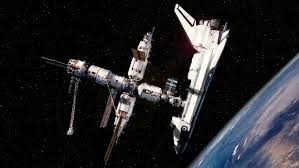
International Space Station Provides New Feelings of Détente

The International Space Station (ISS) circles the globe 15.54 times every 24 hours with a crew of six astronauts. It’s a huge satellite that races around the Earth at 17,500 miles per hour. The international scientists who make up the crew travel in what’s called a low orbit that averages an altitude of 248 miles.

Three American and three Russian astronauts left Earth for the ISS in 2000 to become the first rotating group of scientists to live inside the ISS. The largest structure ever put into space, the ISS covers an area larger than a football field, including the end zones. It’s big enough to be seen at night with the naked eye; it resembles a streaking star as it crosses different parts of the globe. If it were on earth, the massive structure would weigh 400 tons.

The main assembly started in 1998 and went on two years; improvements have continued for the past 19 years. American shuttles and Russian rockets transported pressured modules, external trusses and solar arrays that were assembled in space like a giant erector set. The international mix of scientists who comprise the changing crews of the ISS demonstrate co-operation and trust in working together.

American and Russian governments paid the bulk of the costs to assemble and begin operation of the ISS. The European Space Agency, the Canadian Space Agency and the Japan Aerospace Exploration Agency contribute money to help pay the $100 billion plus dollars spent so far to keep the ISS floating above Earth.

While the two superpowers distrust each other on a political platform, goodwill feelings are strong between Russia and the U.S. concerning the ISS. Trust and co-operation between the U.S. and Russia (formerly the Soviet Union) was at a high water mark in the late 1960’s into most of the 1970’s. That time of mutual trust and co-operation became known as Détente (dey-tahnt). That’s French and means a relaxing of tension, especially between nations, by negotiations and agreement.

At the end of World War II, the Soviet Union and the United States co-existed in a tumultuous time called the Cold War. Both countries competed in manufacturing military buildup including nuclear weapons. Tensions came to a head with the Cuban Missile Crisis in October 1962. It was a dangerous time when the U.S. came close to war with the Soviets.

Détente became a popular idea as leaders and citizens of the two countries realized that the stockpiling of weapons that could destroy Earth several times over was useless and extremely expensive. Efforts to put Americans and Soviets into space helped to overshadow the arms race.

The word Détente slowly left the lexicon of the two countries by the time the Berlin Wall was knocked down in November 1989. That’s when the Soviet Union and communism itself started coming apart.

Scientists who make up the crew of the ISS spend about six months in the satellite before a new crew of astronauts replaces them. The ISS provides a microgravity laboratory where crew members conduct experiments in biology, physics, astronomy, meteorology and other fields. The ISS and future space stations provide excellent opportunities to monitor weather patterns on Earth. Manned exploration to other planets such as Mars would also by greatly helped by such platforms as the ISS.

The ISS is the ninth successful, inhabited space station. Extended funding for the ISS project was approved in March 2017 by both the U.S. and Russia to keep it working through 2024. The replacement for the ISS will be developed and built during the next eight years in Russia by the Roscosmos agency. Roscosmos is the Russian equivalent to America’s NASA.

The commitment to keep funding the ISS for the next seven years gives the two superpowers a chance to keep Détente working in space and maybe, by example, make it spread among all nations.

Wednesday, August 9, 2017

Great American Eclipse Coming August 21st

Millions of Americans will look overhead this month as a total solar eclipse crosses the United States from coast to coast. People in all the contiguous states will see at least a partial eclipse while a narrow band of 14 states will get a full view of the Moon moving between the Earth and Sun.

The eclipse will begin on the Oregon coast as a partial eclipse at 9:06 a.m. Pacific Daylight Time, August 21st. It will end later as a partial eclipse along the South Carolina coast at 4:06 p.m., Eastern Daylight Time.

The Moon’s shadow will block the sunlight for two minutes and 40 seconds, turning day into darkness as the Moon aligns between the Earth and Sun. The air will feel cooler, as much as 10 degrees. Tagged the Great American Eclipse, the entire journey of the Moon’s shadow from the west coast to the east coast will take just 90 minutes.

Scientists will study the eclipse from numerous locations along the narrow band of cities. The next total eclipse that will pass across the U.S. will be in 2024. The last one occurred 99 years ago.

NASA scientists will get the closest look at the eclipse. Several of them will board a specially built Golfstream V jet from Tennessee to record the Moon’s shadow. The astrophysicists will get a very close but a very brief view of the corona. That’s the fuzzy halo that appears around the edges of the Sun when it’s completely covered by the Moon’s shadow.

The corona is what the scientists most want to study. When the Moon shades the brightness of the Sun and the corona is visible, scientists can study the escaping gases that shoot out into space for millions of miles. The corona is visible and safe to watch even to the unaided eye during the brief, total eclipse.

Thousands of photographs will be taken from the ground and from various airplanes in addition to the NASA group flight. The full eclipse takes less than five minutes each time it occurs over and over as the Moon crosses the U.S., so recording the eclipse from several cities will help with the research. 
The Moon will be moving at one and one half times the speed of sound as it crosses the U.S. That’s too fast for the special Golfstream jet to provide more than that one, quick view.

Throughout history, solar eclipses caused fear that resulted in myths and superstitions. Ancient cultures came up with various reasons to understand why the Sun temporarily vanished from the sky. People of ancient China believed that the Sun disappeared because it was eaten by a giant dragon. In fact, the Chinese word for eclipse is shi, which means “to eat.” In Vietnam, people believed a giant frog devoured the Sun. And Norse cultures blamed hungry wolves. Ancient Greeks believed a solar eclipse was a sign from angry gods who were signaling the beginning of pending disasters and destruction on the world.

Irrational fears of solar eclipses exist today. Many cultures around the world see eclipses as evil omens that bring death and destruction. Any such superstitions have no evidence of actually affecting human behavior. Scientists do, however, emphasize that anyone watching a solar eclipse must protect their eyes.

Use eye protection whenever you look at the Sun. The only safe time to watch a total eclipse is during the brief time the Moon’s shadow completely covers the Sun. Otherwise, use specially designed safety glasses that are available from several websites. But the only completely safe way to protect your eyes from sun damage is not to look directly at the sun.

Go outside if you are lucky enough to be in an area where the total or close to total eclipse occurs. The temperature will drop as daylight gives way to partial darkness. And you can watch it in detail on television broadcasts that can show the many photographs and recordings astrophysicists will produce with telescopes and from airplanes.

Tuesday, July 25, 2017

Oldest Known Animal Lived More Than Five Centuries

Two scientists from Bangor University in North Wales found the world’s oldest known living animal, a 507-year-old clam, when they harvested it from the bottom of the Icelandic Ocean in 2006. The remarkable clam was among 200 specimens the scientists scooped from the icy bottom of the ocean to use in researching climate changes over the past 1,000 years.

They named the bivalve Ming the Clam after they determined it was born in 1499 A.D. That was near the middle of the Ming Dynasty that ruled China until 1644. 

After studying the ancient clam, marine geologists Paul Butler and James Scourse announced to the scientific world that they found the world’s oldest known animal. The marine scientists and administrative members for the university in the United Kingdom were criticized for killing the oldest known animal. The marine geologists routinely froze clams they harvested and took them to their lab in the university so they could examine the clams as part of a study about climate changes during the last 1,000 years.

At first inspection, the two researchers found the specimen they named Ming had growth rings indicating that clam was 405 years old. After studying the old clam for a year, they found more growth rings and changed the estimated age to 507 years old. Much like the growth rings found in a tree, a clam grows one ring a year as it matures.   

Butler wrote an article for “Science Nordic” magazine in which he suggested that other clams older than Ming might be found. “Thousands of ocean quahogs are caught commercially every year,” Butler wrote. “So it is entirely likely that some fishermen may have caught quahogs that are as old or even older than the one we caught.”

The Pando Forest
The quahog is the most popular clam used in making chowder. Fishermen bring up thousands of clams from the cold Icelandic Ocean bottom every time their specialized trawlers harvest the bivalves.  Therefore, a clam even older than Ming could make its way into the chowder of an unsuspecting seafood eater.

While Ming holds the record for the oldest animal known, other living earth organisms continue to exist for more than thousands of years. A 106-acre colony of aspen trees in Utah is at least 80,000 years old; some estimates put that age well past 100,000 years. Scientists call the forest Pando. Each tree is a clone (identical duplicate) of the other hundreds of trees in the spectacular forest. All the trees grow from a single, huge, underground root system, making that forest the oldest known living organism on the planet.

The shells for Ming the Clam stay in the research lab inside the North Wales university. No clams even close to the age of Ming have been found yet. Since clam chowder is a popular dish the odds another ancient living animal clam will equal to the 507 years of Ming is anybody’s guess.

Tuesday, June 6, 2017

Star Sirius Inspired Naming Dog Days of Summer


A spring holiday that nudges the start of summer, the recent Memorial Day celebration reminds people that the hottest part of the year is coming soon. The months of July and August bring the uncomfortable, humid weather that many people call the “dog days of summer.”

The phrase “dog days” conjures images of yard mongrels seeking relief in shade and water from summer’s steamy heat. However, it’s the star constellation Canis Major that inspired the name.

Canis Major is a group of stars Greek astronomers named in 700 BC. The constellation represents the dog owned by Orion who appears in the nighttime sky in his own group of stars. Orion is the mighty hunter of Greek and Roman mythology.

The bright star Sirius, the nose of the dog constellation, rises and falls with the sun during July and August in the Western Hemisphere. During summer, Sirius is the brightest object in the sky next to the sun. Ancients believed Sirius, called the Dog Star, added to the summertime heat. That’s how the dog days description began.

A third constellation called Lepus, the rabbit, shares the nighttime sky with Orion and Canis Major. The Dog Star chases Lepus, according to Greek and Roman mythologies. Orion is in the sky with his dog that’s chasing a rabbit, composing a nighttime story in the stars.

Recognizing star constellations requires a stretch in our imaginations. Typically, one major part of a star cluster inspires an imaginary figure. Orion, for example, is recognized by three stars that make up the figure’s belt. The rest of the image of Orion can be described as vague at best. The same is true of Canis Major that has Sirius at the tip of the dog’s nose. The rest of the dog’s figure is difficult to accept.

Image result for sirius radio
Sirius Satellite Radio company hosts a play on words for this constellation using a dog as part of their logo! 

Astrology is an old belief that our futures’ can be predicted from star formations. Recognizing the figures in constellations can be interesting and fun. Entertainment is the best reason to view the nighttime skies.

Sunday, May 21, 2017

Flowers in Bloom Influenced Date for Memorial Day

It’s a federal holiday that honors U.S. military personnel who have died while serving in the country’s armed forces. Memorial Day is designated by law to fall late in May on the last Monday of the month. This year that is May 29, 2017.  

May 30th was the original date for the holiday when it began 149 years ago. Decorating veterans’ graves with flowers became an important part of the holiday, and founders of the tradition decided that flowers would be in bloom by that time of the year. Later, Memorial Day became one of the Monday, three-day weekend holidays when the Uniform Monday Holiday Act went into law on the first day of 1971.

Memorial Day originally was named Decoration Day by members of The General Army of the Republic. Members of that group were mostly widows and families of military members who fought on the Northern side of the American Civil War. They encouraged citizens to decorate the graves of Union war dead with flowers and American flags. Members of the organization started the decorating practice on May 30, 1868, in Decatur, IL, shortly after the end of the Civil War.

Confederate States started their own tradition of placing flowers on the graves of fallen soldiers also in May. The custom of using flowers as decoration was important in both the northern and southern states. In the early 1900s, both northern and southern states used May 30th as the official day.

Military units suffered more than 600,000 casualties during the Civil War. That staggering number of military dead required states on both sides of the war to build many additional cemeteries. New graveyards provided the needed space to bury war causalities, and grieving families used flowers to honor the military.

After World War II most state governments began calling the holiday Memorial Day because that name emphasized honoring the memory of fallen soldiers. The U.S. Congress officially changed the name in 1967.

Because its’s held during warm, spring weather, Memorial Day marks the unofficial start of the vacation season. Labor Day marks the unofficial end of summer.

Formal flag ceremonies honor the more than one million men and women who gave their lives in service to the United States during all American war conflicts. One formal ceremony includes the flagpole in front of the U.S. Capitol Building. The flag that flies above the Capitol is raised to full staff Memorial Day morning and immediately lowered slowly to half-staff.  At noon the flag is raised again to full staff and remains there all day.


Thursday, May 11, 2017

Hyperloop Project Can Move People and Goods Near Speed of Sound

Image result for Hyperloop TrainHyperloop is an experimental, ground transportation system that’s designed to reach speeds faster than 700 mph. Experimental prototypes would hold passengers and freight in a twenty foot capsule that floats inside a partially vacuumed tube. Passengers and freight will travel both above ground and underground.

Magnets work to levitate capsules that get pushed through the tube by high-pressured air. The capsules have accelerated to several hundred miles per hour within seconds during experiments conducted over short distances.

Two major corporations, both located in California, are working to get a functioning Hyperloop system working sometime by 2021. Hyperloop One is a Los Angeles, CA, company that sprung from an idea publicized by Elon Musk, a top official for Spacex, Tesla Inc. and Paypal.  Musk was a concept coordinator for the Hyperloop project when he presented the idea to a national conference in August 2013. He decided not to participate personally in the project.

Hyperloop Transportation Technologies (HTT) is a second company that’s developing the transportation system designed to approach the speed of sound. HTT started in November 2013 and runs its operation in Culver City, CA.

The idea of using air pressure to move objects through a tube is nothing new. Major department stores used a similar method of sending paperwork through elaborate vacuum tubes connected to all floors of the buildings.

Drive-in windows at banks show the concept of Hyperloop transportation. Customers put their bank requests into a capsule that travels through a vacuum tube to an employee several feet away. A vacuum system sends the completed bank transaction inside the capsule back to the bank customer who doesn’t have to leave the car.

Building a Hyperloop system involves putting thousands of miles of tubes above and below ground. These tubes would be approximately nine feet in diameter and would house capsules that would hold about 12 people or a few tons of freight. Both HTT and Hyperloop One plan to build inner-city and suburban systems.

India’s government has an agreement with HTT to build one of the super speed systems between New Delhi and Mumbai. The Hyperloop engineers claim the travel time between the two major cities in India would be reduced to 70 minutes instead of the current train trip of 18 hours.

Image result for Hyperloop TrainOther countries have expressed interest in getting Hyperloop systems inside their borders. The Czech Republic, and the United Arab Emerits invited HTT to build prototype systems for them. Speed estimates include cruising speeds of 650 mph to top speeds faster than the speed of sound at an incredible 800 mph.

Hyperloop engineers claim that the capsules would run completely silent inside the outer tubes. An electrical motor would provide the acceleration and stopping methods of the pods that are designed to float inside the outer shells.

Beach Pneumatic Transit 01.jpg
Beach Pneumatic Transit
A prototype for an underground transit system ran underneath New York City from 1870 to 1873. The Beach Pneumatic Transit carrier put passengers into a railroad-type vehicle that moved by an air propulsion method similar to the Hyperloop. Up to 22 people were moved underneath Broadway for about one city block when the vehicle stopped and reversed direction to carry passengers back to the start of the tunnel. 

Passengers paid 25 cents to ride the transit car one city block and back. More than $7,000 was collected annually during the first two years of the prototype’s operation. It was more a curiosity than a practical way of transporting passengers, but the experiment proved the validity of using air pressure to move people from one spot to another worked.

Alfred Ely Beach was the developer and chief inventor of the transit system. He spent $350,000 of his own money to finance the experiment. That equals $8.75 million in today’s dollars. Beach wanted to increase the tunnel distance to five miles in the second phase of the transit operation. However, public interest in the tunnel diminished during the third year, and city government officials refused to raise tax money to fund the project.

Developers of Hyperloop One and HTT keep speculating that they will get a working system operational sometime before 2021. Their optimism is farfetched since the basic ground work is in the infancy stage.

Officials have estimated costs would be somewhere from 200 million to 400 million per mile to construct the first Hyperloop. That’s not more than a wild guess. The backers for Hyperloop One and HTT will have to be wealthy nations to make the superfast transportation systems a reality. 

Transportation of freight, goods and products is the future of the Hyperloop. Passenger costs will be so expensive that only wealthy citizens will travel at the supersonic speeds. That was found to be true during the short-lived SST super airplanes that traveled at the speed of sound decades ago.